2023年4月16日 星期日

富爸窮爸 目錄 & 介紹 L2~L6

Contents

Introduction
Rich Dad Poor Dad
Chapter One
Lesson 1: The Rich Don’t Work for Money
Chapter Two
Lesson 2: Why Teach Financial Literacy ?
Chapter Three
Lesson 3: Mind Your Own Business
Chapter Four
Lesson 4: The History of Taxes and the Power of Corporations
Chapter Five
Lesson 5: The Rich Invent Money
Chapter Six
Lesson 6: Work to Learn — Don’t Work for Money
Chapter Seven
Overcoming Obstacles
Chapter Eight
Getting Started
Chapter Nine
Still Want MoreHere Are Some To Do’s
Final Thoughts

Introduction
RICH DAD POOR DAD

I had two fathersa rich one and a poor oneOne was highly educated and intelligentHe had a Ph.D. and completed four years of undergraduate work in less than two yearsHe then went on to Stanford Universitythe University of Chicago, and Northwestern University to do his advanced studiesall on full financial scholarships . The other father never finished the eighth grade.

Both men were successful in their careersworking hard all their livesBoth earned substantial incomesYet one always struggled financiallyThe other would become one of the richest men in Hawaii. One died leaving tens of millions of dollars to his familycharitiesand his churchThe other left bills to be paid.

Both men were strong, charismatic, and influentialBoth men offered me advicebut they did not advise the same thingsBoth men believed strongly in education but did not recommend the same course of study.

If I had had only one dadI would have had to accept or reject his adviceHaving two dads offered me the choice of contrasting points of viewone of a rich man and one of a poor man.

Instead of simply accepting or rejecting one or the otherI found myself thinking morecomparingand then choosing for myselfThe problem was that the rich man was not rich yetand the poor man was not yet poorBoth were just starting out on their careersand both were struggling with money and familiesBut they had very different points of view about money.

For exampleone dad would say, “The love of money is the root of all evil.” The other said, “The lack of money is the root of all evil.”

As a young boyhaving two strong fathers both influencing me was difficultI wanted to be a good son and listenbut the two fathers did not say the same thingsThe contrast in their points of viewparticularly about moneywas so extreme that I grew curious and intriguedI began to start thinking for long periods of time about what each was saying.

Much of my private time was spent reflectingasking myself questions such as, “Why does he say that?” and then asking the same question of the other dad’s statementIt would have been much easier to simply say, “Yeahhe’s rightI agree with that.” Or to simply reject the point of view by saying, “The old man doesn’t know what he’s talking about.” Insteadhaving two dads whom I loved forced me to think and ultimately choose a way of thinking for myselfAs a processchoosing for myself turned out to be much more valuable in
the long run than simply accepting or rejecting a single point of view.

One of the reasons the rich get richerthe poor get poorerand the middle class struggles in debt is that the subject of money is taught at homenot in schoolMost of us learn about money from our parentsSo what can poor parents tell their child about money?
They simply say, “Stay in school and study hard.” The child may graduate with excellent gradesbut with a poor person’s financial programming and mindset.

Sadlymoney is not taught in schoolsSchools focus on scholastic and professional skillsbut not on financial skillsThis explains how smart bankersdoctorsand accountants who earned excellent grades
may struggle financially all of their livesOur staggering national debt is due in large part to highly educated politicians and government officials making financial decisions with little or no training in the subject of money.

Today I often wonder what will soon happen when we have millions of people who need financial and medical assistanceThey will be dependent upon their families or the government for financial supportWhat will happen when Medicare and Social Security run
out of moneyHow will a nation survive if teaching children about money continues to be left to parents -- most of whom will beor already arepoor?

Because I had two influential fathersI learned from both of themI had to think about each dad’s adviceand in doing soI gained valuable insight into the power and effect of one’s thoughts on one’s lifeFor exampleone dad had a habit of saying, “I can’t afford it.” The other dad forbade those words to be usedHe insisted I ask, “How can I afford it?” One is a statementand the other is a questionOne lets you off the hookand the other forces you to thinkMy soon-to-be-rich dad would explain that by automatically saying the words “I can’t afford it,” your brain stops workingBy asking the question “How can I afford it?” your brain is put to workHe did not mean that you should buy everything you wantHe was fanatical about exercising your mindthe most powerful computer in the worldHe’d say, “My brain gets stronger every day because I exercise itThe stronger it getsthe more money I can make.” He believed that automatically saying “I can’t afford it” was a sign of mental laziness.

Although both dads worked hardI noticed that one dad had a habit of putting his brain to sleep when it came to financesand the other had a habit of exercising his brainThe long-term result was that one dad grew stronger financiallyand the other grew weakerIt is not much different from a person who goes to the gym to exercise on a regular basis versus someone who sits on the couch watching televisionProper physical exercise increases your chances for healthand proper mental exercise increases your chances for wealth.

My two dads had opposing attitudes and that affected the way they thoughtOne dad thought that the rich should pay more in taxes to take care of those less fortunateThe other said, “Taxes punish those who produce and reward those who don’t produce.”

One dad recommended, “Study hard so you can find a good company to work for.” The other recommended, “Study hard so you can find a good company to buy.”

One dad said, “The reason I’m not rich is because I have you kids.” The other said, “The reason I must be rich is because I have you kids.”

One encouraged talking about money and business at the dinner tablewhile the other forbade the subject of money to be discussed over a meal.

One said, “When it comes to moneyplay it safeDon’t take risks.” The other said, “Learn to manage risk.”

One believed, “Our home is our largest investment and our greatest asset.” The other believed, “My house is a liabilityand if your house is your largest investmentyou’re in trouble.”

Both dads paid their bills on timeyet one paid his bills first while the other paid his bills last.

One dad believed in a company or the government taking care of you and your needsHe was always concerned about pay raisesretirement plansmedical benefitssick leavevacation daysand other perks. He was impressed with two of his uncles who joined the military and earned a retirement-and-entitlement package for life after twenty years of active serviceHe loved the idea of medical benefits and PX privileges the military provided its retirees. He also loved the tenure system available through the universityThe idea of job protection for life and job benefits seemed more importantat timesthan the jobHe would often say, “I’ve worked hard for the governmentand I’m entitled to these benefits.”

The other believed in total financial self-relianceHe spoke out against the entitlement mentality and how it created weak and financially needy peopleHe was emphatic about being financially competent.

One dad struggled to save a few dollarsThe other created investmentsOne dad taught me how to write an impressive resume so I could find a good jobThe other taught me how to write strong business and financial plans so I could create jobs.

Being a product of two strong dads allowed me the luxury of observing the effects different thoughts have on one’s lifeI noticed that people really do shape their lives through their thoughts.

For examplemy poor dad always said, “I’ll never be rich.” And that prophecy became realityMy rich dadon the other handalways referred to himself as richHe would say things like, “I’m a rich manand rich people don’t do this.” Even when he was flat broke after a major financial setbackhe continued to refer to himself as a rich manHe would cover himself by saying, “There is a difference between being poor and being brokeBroke is temporaryPoor is eternal.”

My poor dad would say, “I’m not interested in money,” or “Money doesn’t matter.” My rich dad always said, “Money is power.”

The power of our thoughts may never be measured or appreciatedbut it became obvious to me as a young boy that it was important to be aware of my thoughts and how I expressed myselfI noticed that my poor dad was poornot because of the amount of money he earnedwhich was significantbut because of his thoughts and actionsAs a young boy having two fathersI became acutely aware of being careful about which thoughts I chose to adopt as my ownShould I listen to my rich dad or to my poor dad?

Although both men had tremendous respect for education and learningthey disagreed about what they thought was important to learnOne wanted me to study hardearn a degreeand get a good job to earn moneyHe wanted me to study to become a professionalan attorney or an accountantand to go to business school for my MBA. The other encouraged me to study to be richto understand how money worksand to learn how to have it work for me. “I don’t work for money!” were words he would repeat over and over. “Money works for me!”

At the age of nineI decided to listen to and learn from my rich dad about moneyIn doing soI chose not to listen to my poor dadeven though he was the one with all the college degrees.
______________________
There is a difference between being poor
and being broke.
Broke is temporary.
Poor is eternal.
_______________________
A Lesson from Robert Frost
Robert Frost is my favorite poetAlthough I love many of his poemsmy favorite is “The Road Not Taken.” I use its lesson almost daily.

The Road Not Taken
Two roads diverged in a yellow wood,
And sorry I could not travel both
And be one travelerlong I stood
And looked down one as far as I could
To where it bent in the undergrowth;
Then took the otheras just as fair,
And having perhaps the better claim,
Because it was grassy and wanted wear
Though as for that the passing there
Had worn them really about the same,
And both that morning equally lay
In leaves no step had trodden black.
OhI kept the first for another day!
Yet knowing how way leads onto way,
I doubted if I should ever come back.
I shall be telling this with a sigh
Somewhere ages and ages hence;
Two roads diverged in a woodand I
I took the one less traveled by,
And that has made all the difference.

And that has made all the difference.

Over the yearsI have often reflected upon Robert Frost’s poemChoosing not to listen to my highly educated dad’s advice and attitude
about money was a painful decisionbut it was a decision that shaped the rest of my life.

Once I made up my mind about whom to listen tomy education about money beganMy rich dad taught me over a period of 30 years until I was 39 years oldHe stopped once he realized that I knew and fully understood what he had been trying to drum into my often-thick skull.

Money is one form of powerBut what is more powerful is financial educationMoney comes and goesbut if you have the education about how money worksyou gain power over it and can begin building wealthThe reason positive thinking alone does not work is because most people went to school and never learned how money worksso they spend their lives working for money.

Because I was only nine years old when I startedthe lessons my rich dad taught me were simpleAnd when it was all said and donethere were only six main lessonsrepeated over 30 yearsThis book is about those six lessonsput as simply as possiblejust as simply as my rich dad put forth those lessons to meThe lessons are meant not to be answersbut guideposts that will assist you and your children to grow wealthier no matter what happens in a world of increasing change and uncertainty.

2023年4月10日 星期一

World History

Chapter 3 

Ancient India and China: Civilization spreads east

The Steppes

Silk Road Himalaya Mts. Yellow River

Indus River

A

Asia Minor (Turkey)

Japan

East

Asia

China

Yangtze

River,

AFRICA

India

Ganges

River

Southern Ocean Trade Routes

LOCATIONS: India, China, Japan, Asia Minor (Turkey), East Asia, Indus River, Yellow River, the Steppes, Silk Road, southern ocean trade routes, Himalaya Mountains.

Preview

After the world's first major civilizations arose in the Middle East, trade and civilization spread eastward to the Indus River valley of India. India was the birthplace of two major world religions, Hinduism and Buddhism, and India is the source of our zero-based numbering system. India would become the hub of a large trading network that extended from Europe all the way to China.

China, the world's fourth early civilization, also began in a river valley: the Yellow River valley of northern China. After China expanded south to the Yangtze River valley, the land between the two rivers became China's heartland, known as the "Middle Kingdom." After a ruthless emperor took control of China, it became the superpower of Asia.


29. Asia

Asia is the world's largest continent, sharing the landmass of Eurasia with Europe. The Ural Mountains of Russia are considered the dividing line between Asia and Europe. Asia was the site of three of the world's earliest civilizations, in Mesopotamia, India, and China. Today Asia has three-fifths of the world's population and the two most populous countries in the world, China and India. Because Asia is so huge, geographers have divided Asia into several regions. On the western side of Asia is the Middle East, which includes Asia Minor (present-day Turkey). Farther east is central Asia. To the south lies the Indian subcontinent. On the eastern side of Asia are East Asia (sometimes called the Far East) and Southeast Asia.

30. India

Most of the country of India is a triangular shaped peninsula that juts into the Indian Ocean. Due to its central location on the Indian Ocean between China and the Middle East, India became the ancient world's largest trading center. India also gave the world important new ideas, including the numbering system we use today and the religions of Hinduism and Buddhism. Today India is the second most populous country in the world after China, and India is the world's largest democracy. The capital of India is New Delhi. India and nearby countries form a region known as the Indian subcontinent, or Southern Asia,

After civilization first emerged in Mesopotamia and Egypt, it spread east to India. The earliest civilization in India grew along the Indus River valley of western India (now Pakistan) around 2500 BC. The Indus Valley Civilization had a written language and large cities with sophisticated plumbing systems. These were the first people to grow cotton. Ships and overland trade caravans connected India to Mesopotamia and Egypt in an early international trading network. The Indus Valley Civilization lasted for about a thousand years before it went into decline, possibly due to climate change that brought cooler and dryer weather.

31. the caste system

Under ancient India's caste system, people were born into permanent classes for life, and they could marry only within their own caste There were four main castes with complicated rules of behavior: (1) the priests, (2) the warriors, (3) the merchants, and (4) the common people, mostly peasants and laborers. Most people of ancient India were members of the commoner class, which had limited rights.

A fifth group, the Untouchables, was outside the caste system. Considered not fully human, Untouchables performed the worst jobs such as skinning animals, cleaning toilets, and burying the dead.

While the caste system may seem unfair to us today, it provided a means for different kinds of people to live together peacefully while avoiding the slavery common to many ancient cultures. Although discrimination based on caste has been outlawed in India for decades, it still influences what kind of jobs people can get and whom they will marry.

32. Hinduism

Hinduism is the oldest major religion in the world today; it survived so long by changing and adjusting to new circumstances. To Hindus, all religions are acceptable, and the practices of other religions may be included as part of Hindu worship. Hindus believe in an eternal and infinite spiritual principle called Brahman that is the ultimate reality and foundation of all existence. Brahman can take the form of many gods, including Brahma the creator of the universe, Vishnu the preserver, and Shiva the destroyer.

For Hindus, a proper life is unconcerned with worldly riches; the goal is to seek union with Brahman, a quest that may take many lifetimes. Hindus believe in reincarnation, meaning that the soul never dies and may be reborn again in a different body. Karma, all of the actions of a person's life, will determine if a person returns in the next life at a higher level on the ladder of incarnation and closer to union with Brahman.

Hinduism is the largest religion of India and a defining feature of Indian culture. Hinduism and the caste system served to maintain order among India's many ethnic groups because each person knew his or her place in society, and people who followed the rules could hope to move to a higher caste in the next life.

33. Buddhism

Not everyone in India was satisfied with Hinduism. In the 500s BC, a young Hindu prince raised in luxury became troubled by the suffering he saw in the world. He left his wife and infant son to become a wandering monk, seeking a way to end the suffering. After six years of solitary searching, he found an answer and began to teach. His followers called him the "Buddha," or "the enlightened one." Buddha taught that our life in the physical world is merely an illusion When people let go of their worldly pain and worries, they can unite with the universal soul and achieve a state of complete peace called nirvana.

Like Hindus, Buddhists believe nothing is permanent, that life constantly moves through cycles of birth, death, and rebirth like the turning of a wheel. Although Buddha accepted the Hindu belief in reincarnation, he taught that people could achieve nirvana from their actions in this life alone, and he rejected the caste system. For these reasons, Buddhism became popular among the lower classes in India.

Today Buddhism is a major world religion. Although it began in India, Buddhism spread to the east and declined in India as Buddhism was absorbed into Hinduism. Buddhists are now found in the greatest numbers in East Asia and Southeast Asia.

34. Ashoka

Centuries after the Indus Valley Civilization died, cities and civiliza- tion arose again farther to the east in the fertile Ganges River valley. India was torn by warfare between kingdoms until the first Indian empire was established in the Ganges valley by the Mauryan Dynasty in 324 BC. Its greatest leader was Ashoka, who extended his empire to the south in a bloody invasion that conquered all but the southern tip of India.

Then Ashoka had a sudden change of heart. He publicly announced his grief at the suffering caused by his armies, and he rejected violence. He even gave up hunting and eating meat. Ashoka converted to Buddhism, and he spread Buddhist thinking throughout India and to neighboring countries. Ruling India with Buddhist ideals, Ashoka's government promoted the welfare of the people by kind acts such as digging new wells, building hospitals for people and animals, allowing freedom of religion, and easing harsh laws.

Ashoka also encouraged long-distance ocean trade. It was during his reign that India became the center of a vast, southern ocean-trading network that stretched from China to Africa and the Middle East.

35. Gupta Empire

Historians consider the Mauryan Empire and the Gupta Empire that followed (in the 300s and 400s AD) to be the greatest civilizations of India's classical period, a period when India underwent great cultural and political advancement. The reign of the Gupta Empire has been called India's "golden age," a high point of Indian history when art, drama. literature, and science flourished.

Gupta mathematicians invented the zero, an amazing number with no value that gives value to the place of other numbers. The zero made it possible to calculate numbers faster and more accurately, and it was adopted the world over. Doctors developed an inoculation against smallpox.

Farmers learned how to turn the juice from sugarcane into dried sugar crystals that could be easily stored and traded over long distances. Cette from India clothed people across much of the ancient world. Gupta Indie was a land of wonders.

The Gupta Empire declined in the early 500s AD when tribes of nomadic horsemen called Huns invaded from grasslands to the north but the cultural patterns that developed during India's classical period created a vital culture in Southern Asia that endures to this day."

36. nomadic raiders

People of ancient times developed four basic patterns for making a living. Some were still hunters and gatherers stalking wild game herds. but most people lived in farming villages. Another group lived in cities supported largely by wealth from agriculture. A fourth group lived in pastoral societies; these were nomadic herders of the grasslands who did not settle down in one place like farmers. They moved their domes- ticated (tame) animals-sheep, goats, cows, horses, and camels-from pasture to pasture with the seasons.

Pastoral people were mobile, and they developed military tactics to protect their animals from thieves. Pastoral nomads of the steppes (grasslands of central Eurasia) became skilled at using horses in warfare. and they sometimes raided settled communities. These were the nomadic raiders who attacked Jericho, Sumer, the Gupta Empire, and others Many governments of Eurasia began with nomads sweeping in from the steppes and taking control. Centuries of warfare between nomadic raiders and civilized peoples in Eurasia led to advancements in military organization and technology unmatched elsewhere in the world.

37. China

The world's fourth great, early civilization also got its start along river valley, the Yellow River of northeastern China, where farmers grew millet and wheat Farming later moved south to the Yangtze (YONG-zah) river, where rice production led to an increase in China's population The land between the rivers became the center of Chinese civilization the so-called Middle Kingdom. Early Chinese culture grew in relative isolation due to physical barriers and long distances that separated it from other major civilizations of Eurasia. The world's highest mountain range, the Himalayas, separates China from India.

The Chinese have long believed in a philosophy that recognizes fundamental balance in nature between opposite but complimentary principles called yin and yang. Examples include day/night, hot/cold. wet/dry, and male/female. Central to Chinese philosophy and religion is a belief that people should avoid extremes and seek harmony with the balance of nature. (A philosophy is a system of basic beliefs about life.) With nearly one fourth of the world's population, China today is

the world's most populous country, and it has a fast-growing economy. China was a superpower in the past, and it has become a superpower again in this century. China and its neighboring countries of Mongolia, Korea, and Japan form a region bordering the Pacific Ocean known as East Asia or the Far East.

38. mandate from heaven

The Zhou (JOH) dynasty took control of China in 1122 BC and ruled for nearly 900 years. To give their government legitimacy, Zhou and later Chinese rulers claimed to rule with approval from the gods, a mandate from heaven. Although this claim was meant to enhance the emperor's authority, it also established the right to overthrow an ineffective emperor. The emperor was expected to protect his people by ruling in a way that pleased the gods. If trouble developed in the empire-droughts or military defeats, for example-people might say the emperor had lost his mandate from heaven, and the emperor could be overthrown.

Over many centuries, China's history experienced a recurring pattern. A ruling dynasty would start out strong and gradually weaken over time until it was replaced by a new dynasty. Then the pattern would repeat.

Zhou rulers controlled their kingdom through a feudal system, meaning that they divided the land into smaller territories and appointed officials to govern them. When the Zhou dynasty eventually weakened, some of these territories developed into strong states that opposed the emperor and began fighting among themselves. These bloody conflicts lasted for over two centuries, a time called the Warring States period.

39. Confucius

Confucius was born in 551 BC, when Zhou rulers were losing control of their empire. He tried to return harmony to China with a philosophy based on devotion to the family, respect between the classes, high moral ideals, and learning. He emphasized individual duty and responsibility, what we might call a strong work ethic. The family was the center of Confu cian society, with the father at the head. The mother and children owed total

obedience to the father. Family ancestors were honored and not forgotten. Confucius promoted an orderly society in which people of higher rank were courteous to those below, and those of lower rank were respectful lead by example, not through power and harsh laws. "When the ruler to those above. Confucius said a ruler should act like a good father and does right, all men will imitate his self-control."

While the teachings of Confucius were not very influential in his lifetime, they soon became a guiding philosophy of Chinese civilization, and they still exert a strong influence on Chinese culture today.

40. The First Emperor

One of China's warring states, the Qin (CHIN) kingdom of western China, grew wealthy from agriculture based on extensive irrigation. With this wealth, the Qin ruler raised a powerful army and spent twenty years ruthlessly conquering China's warring states. He declared himself First Emperor in 221 BC. Thus, it was the First Emperor, Qin Shi Huangdi, who brought China under a central government and gave China its name,

To help unify China, the First Emperor stripped the regional warlords of their power, and he forced them to move to the capital where he could control them. He also standardized the Chinese language, money, roads, and weights and measures.

The First Emperor ruled with a philosophy that considered people selfish and evil by nature; he adopted strict laws and harsh punishments to keep people in line. He also tried to control what people could think, it is said that he buried scholars alive, burned books including the teachings of Confucius, and brutally eliminated those who disagreed with him.

41. Great Wall of China

Natural barriers protected China on three sides: oceans to the east and south, mountains and desert to the west. But China's northern border lay open to attack from Huns. The First Emperor ordered a number of individual walls joined together to form one great stone wall to defend China's northern border from attack. Hundreds of thousands of laborers worked on the Great Wall for years, and many workers died under the harsh conditions. Gates in the wall became centers of trade with the nomadic peoples who lived outside. The Great Wall was repaired and

rebuilt a number of times over the centuries, and parts of it still stand. The First Emperor also built for himself a magnificent underground tomb, and nearby he buried a terra-cotta army of life-size soldiers to protect him for eternity. (Terra-cotta is the brownish-orange pottery used today to make flowerpots.) One pit contained sculptures of 6,000 Infantrymen (foot soldiers), and a second pit held the cavalry (mounted soldiers) complete with life-size horses, all arranged in battle formation One of the great archeological finds of the 20th century, the terra-cotta army was uncovered accidentally in 1974 by a farmer digging a well

Hoping to find a way to avoid death, the First Emperor experimented with a number of potions until he killed himself by accidental poisoning. The Qin Dynasty lasted for only fifteen years, but it began a Chinese tradition of strong central governments controlled by powerful rulers.

42. Han Dynasty

The harsh rule of the First Emperor was so unpopular that the Qin Dynasty was overthrown shortly after the emperor's death. Following a period of civil war, the Han Dynasty took control of China in 206 BC. Han rulers adopted Confucian ideas about creating a respectful and orderly society, and they set up a civil service system to run the govern- ment with well-educated officials chosen by written tests.

The Han Dynasty expanded China's empire to the south and west. and it produced marvels that would change the world, including the ship's rudder, the magnetic compass, and paper. The four-hundred-year reign of the Han Empire was so successful that it is considered the greatest of China's classical dynasties.

The Han Empire eventually weakened, fell apart, and was replaced by three kingdoms in 220 AD. About a hundred years later, Hun invaders took control of the Chinese heartland. The period of classical civilization in China was over, but the Chinese were left with an enduring belief that China was the center of civilization.

43. the Silk Road

During the Han Dynasty, regular trade began over the Silk Road, actually a network of trails that stretched 4,000 miles from China to the Roman Empire. Only the Chinese knew how to raise silkworms and weave silk: Chinese silk was worth its weight in gold in Rome. Europeans also acquired a taste for other Asian luxury goods including spices, a taste that would later send Columbus on his voyages of discovery.

The Silk Road was a two-way street. Asian goods were traded for Western goods, which flowed back along the Silk Road to China. Imports from the west to China included gold, silver, powerful horses, new foods, and Buddhism. This overland trade was made possible by the camel, the "ship of the desert," with its large padded feet for walking on shifting desert sands and its ability go long distances without food or water.

Trade routes such as the Silk Road were pioneered by nomads. For a price, nomads provided caravans with pack animals and protection. The Silk Road in the north joined with the southern ocean shipping routes to form a trading web that spread goods, technologies, and ideas between Asia, Europe, and North Africa.

44. Iron Age

Advanced Bronze Age civilizations of the eastern Mediterranean and Middle East collapsed around 1200 BC following attacks from a group of raiders known as the "Sea Peoples." Little is known about where the Ses Peoples came from and what caused them to move into new territories but disruption of the bronze trade led to a transformation to a newer metal technology, iron.

This is when people learned how to use a draft of air from a furnace or bellows to produce the hot temperatures needed to melt iron from iron ore and to shape it into tools and weapons. Iron was much stronger than bronze, and it was less expensive because iron ore was easier to find than the tin needed to make bronze. Iron working not only mean better tools and weapons, it meant many more of them, a major ted nological change.

After iron working began in the Middle East, it spread to India and to much of the civilized world. Iron had a big impact on agriculture and warfare. Iron plow blades and hoes made it possible to work heavier soil than before, extending agriculture into new lands and boosting human populations. Armies grew bigger and deadlier due to more effective and less expensive iron weapons and armor. There is no definite ending date for the Iron Age, but people today might say we live in the "Industrial Age" or the "Digital Age."

Some questions to consider:

If you were sent on a mission to establish a new civilization on a distant planet similar to earth, where would you locate your civiliza tion? Why?

What gives a government the right to rule over people?

Are harsh punishments needed to keep people in line?

If the Buddha were alive today, would he still wonder why there is so much suffering in the world?

The arrival of iron technology changed the world in big ways it possible to predict how new technologies will change our world it the future?


Chapter 4

Ancient Greece and Rome: Civilization spreads west

Constantinople (Istanbul)

Italy Athens

Black Sea

Alps

Rome

Crete

Carthage Greece

Persian Empire

Roman Empire

Alexandria

LOCATIONS: Greece, Crete, Black Sea, Athens, Persian Empire (Iran), Alexandria, Italy, Rome, Roman Empire, Carthage, Alps, Constantinople (Istanbul)

Preview

Ancient times began with river valley civilizations, and ancient times ended about 4,000 years later when nomadic raiders brought down great classical civilizations in India, China, and the Mediterranean. This chapter explores the Mediterranean cultures of ancient Greece and Rome, which exerted a great deal of influence on the present-day culture of the Western world.

Classical Greece is considered the birthplace of Western Civilization because it originated many aspects of our culture including literature, philosophy, art, the Olympic games, and democracy. As Greek civiliza- tion declined, Roman power grew. Romans learned from the Greeks and made their own contributions to Western Civilization including a legal system and the alphabet we use today.

37


2023年4月1日 星期六

排行榜

112/04/01(六)
請私訊傳回你自己的排行榜。

以下A~E五部影片,請按個人喜好順序,依照#1~#5排序,私訊上傳,
例如:
#1 E
#2 A
#3 B
#4 C
#5 D

不雅廣告請勿開啟,以免造成手機電腦當機中毒。

A    Growing Pain 成長的煩惱》S01E01
https://www.ixigua.com/6846605675561222660?logTag=3L2mk8BciDECCYfOmJ55g&fbclid=IwAR0USWrpntv_vCGfZxlhj5Qdj89ra86muW-DdRExxeZWpJlFdYWvxbmlJ28&wid_try=1


B    The Simpsons 辛普森家庭》S21E01
https://gimy.app/eps/229482-1-1.html

C    Teen Titans GO! to the Movies (2018)    少年泰坦出擊電影版
https://8maple.in/27165968-hd/

D    Batwheels | Ready, Steady, Redbird! | 超級蝙蝠車
https://www.youtube.com/watch?v=YucaNFGxIsg

E    Downton Abbey 唐頓莊園》S01E01
https://dramaq.one/tv/west/201075253/ep1.html


C    Teen Titans GO! to the Movies (2018)    少年泰坦出擊電影版
https://8maple.in/27165968-hd/
https://www.drama777.com/vod-play-48169865-zheng-pian.html


2023年2月4日 星期六

紅色GB HW 範圍

紅色GB HW 範圍
提醒你,作答時,
除了標題須載明是
紅色GB第幾章別,每一個習題必須標出頁數別和習題別。
例如:
P119 Ex36

第四章和第五章該完成的習題(exercises):
CH 4 習題(Ex)
1
2
3
8
9
10
11
12
13
14
17
19
20
22
23
26
27
29
30
32
34
36
42
43

CH 5 習題(Ex)
1
2
4
6   Part2
13
18
23
25 #1~#7
27
28
30
34 Part2
35 Part2
36 Part2
38
44 Part2
45 Part2
46 Part2
48
49

2023年2月2日 星期四

英閱 Human Body


Do you have a favorite memory? Is it a kitten purring on your lap as you stroked its warm, silky fur? Or is it zooming downhill on a shiny new bike with wind whistling in your ears?


Maybe it's the smell of a Christmas tree in your house in December. Whatever your favorite memory is, you have it because of your five senses: sight, hearing, touch, taste, and smell. The senses are how we experience the world.


Almost everyone knows what it's like to lose one of the five senses, if only for a short time. You may have tried to pin the tail on the donkey while blindfolded. Or maybe you covered your ears when a loud train raced by. It's almost impossible to taste and smell if you have a cold. A shot from the dentist can take away the sense of touch in your mouth. But to imagine life without any of your senses is impossible. You experience life through the senses.


This kid is experiencing life through all five senses: sight, hearing, touch,

taste, and smell.


Different parts of the brain get information from each of the senses. Let's say your brain gets news from your nose that something smells good. The brain may tell your hand to grab a fork and dig in. Or the brain may get news that a car is coming down the street. It will tell your feet to stay on the sidewalk.


Animals have all the senses people do, but they may work differently. A cat, for instance, sees some colors but not as brightly as people do.


Sight
Every day, your five senses bring you information about the world. But they are not equal partners in the job. Eighty percent of the information your brain gets comes through your eyes unless you are blind.


Yet, in a sense, your eyes do not see. They basically collect light. Your brain turns the collected light into images that make sense. In other words, what you "see" with your eyes has no meaning to you until your brain makes sense of it.


Your brain also lets you “see” events from the past. You may recall last year's birthday party. You can imagine scenes that have never been. Can you “see” yourself being elected president? Even someone who goes blind in later life can recall visual images, thanks to the brain.


So, we know the brain plays a major role in the sense of sight. Still, the eyes are super important. Without them collecting light, the brain would have no raw material to work with.


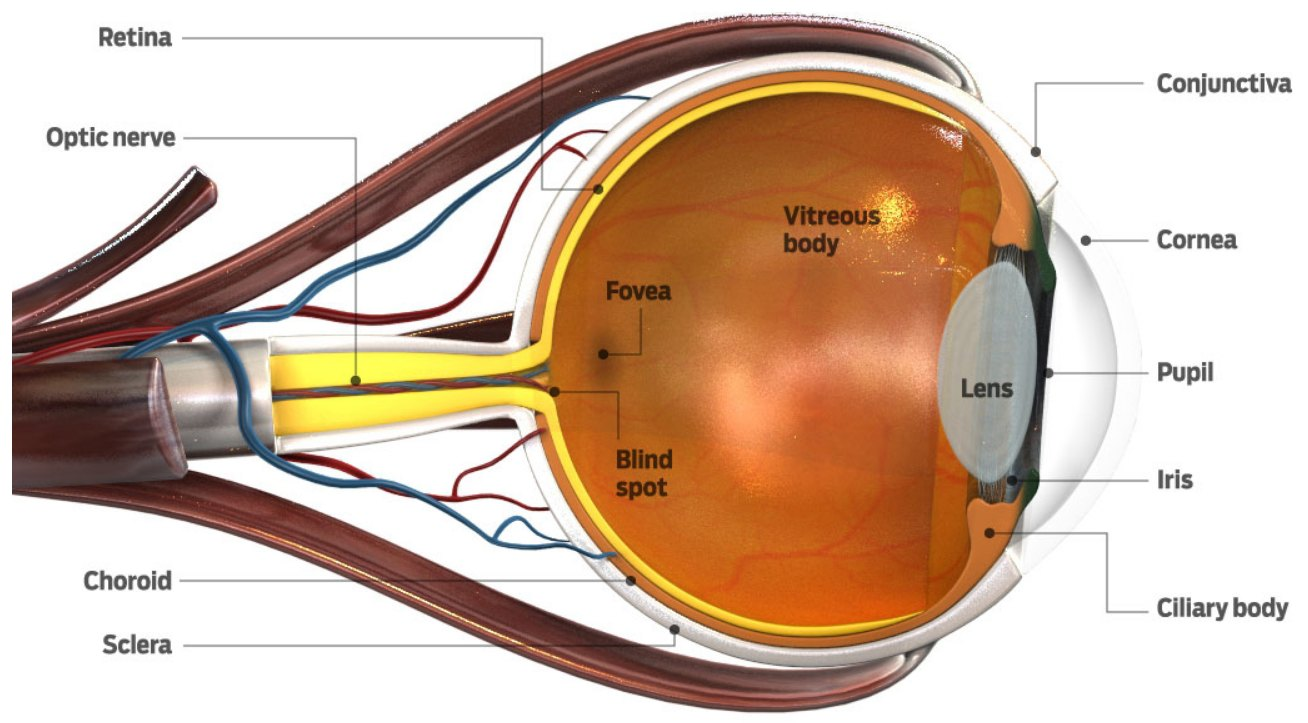
Use your mouse or finger to scrub through the animation below.


Retina

Optic nerve

Conjunctiva

Vitreous body

Cornea

Fovea

Pupil

Lens

Blind spot

Iris

Choroid

Sclera

Ciliary body


Light enters the eye through the pupil.

That's a hole in the iris. Behind the iris, the lens focuses images onto the retina. The retina turns light rays into electrical impulses. The optic nerve carries these impulses to the brain.


Birds of prey need great eyesight. Some can spot a mouse on the ground from several hundred feet in the air. If an eagle could read, it could read this screen from 230 feet away. That's as tall as a 20-story building.


Stevie Wonder was born blind. He became a recording artist when he was just ten. He sings, composes, and plays the piano, clarinet, drums, organ, and harmonica.


Of course, plants do not have eyes. But at least one plant has a sense of sight. The fungus Pilobolus has an area that is sensitive to light. The fungus aims its spores at the lightest spot it can find. This gives it a better chance of survival.


未提供相片說明。

You see in color because of rods and cones. These cells are in the retina. About 125 million rod cells in each eye work well in dim light. They see in shades of gray. Six million cone cells in each eye respond to color.


可能是黑白圖像

可能是一或多人和顯示的文字是「 Check It Out! Optical illusions can play tricks on our eyes. Look at the two horizontal lines aoooe and figure out which is longer. VIEW ANSWER 」的圖像

Check It Out!

Some pictures, often called optical illusions, play tricks on our eyes. Look at the two horizontal lines above and figure out which is longer.

VIEW ANSWER

可能是顯示的文字是「 Check It Out! Both lines are the same length. BACKTO QUESTION 」的圖像

Both lines are the same length.

BACK TO QUESTION


未提供相片說明。

可能是顯示的文字是「 Check It Out! Look at the the two shapes above. Which is smaller? VIEW ANSWER 」的圖像

Check It Out!

Look at the two shapes above. Which is

smaller?

VIEW ANSWER

可能是顯示的文字是「 Check It Out! Both shapes are the same size. BACK To QUESTION 」的圖像

Both shapes are the same size.

BACK TO QUESTION

可能是 1 人的圖像

What do microscopes, binoculars, and telescopes all have in common? They all have lenses, of course. And they are all meant to make our eyes stronger. There are two main kinds of microscopes. An optical microscope bends light rays passing through an object. The bent rays then join to form an enlarged image. Such a microscope can make an image up to 2,000 times bigger. The electron microscope is a newer invention. Instead of light rays, it uses a beam of electrons to magnify. Electrons are negatively charged particles of an atom. An electron microscope can enlarge an object up to 2 million times!


可能是 1 人、小孩和戶外的特寫

可能是一或多人和顯示的文字是「 Check It Out! Tears, which keep eyes clean and moist, come from glands over the eyes. They drain into the nose and eventually get swallowed. Can Can you figure out why your nose runs when you're crying? VIEW ANSWER 」的圖像

Check It Out!

Tears keep eyes clean and moist. They come from glands over the eyes and drain into the nose. Eventually they are swallowed. Can you figure out why you get a runny nose when you cry?

VIEW ANSWER

Harry1AP26~P30

  I   know   they   don't ,"  said  Harry. " It   was   only   a   dream ." But   he   wished   he   hadn't   said   ...